
Student Protections at Gavilan College
Your Safety Matters!
We all have certain basic rights under the U.S. Constitution, regardless of immigration status.
If you are stopped by law enforcement, you can choose to remain silent, not consent to a search, and to ask for a lawyer. Remember: anything you tell an officer can be used against you and immigration court. Get more detailed information at the American Civil Liberties Union (ACLU).
Click here for more resources.
Data Safety
The information you provide when you apply to college is protected!
Gavilan College follows all federal and state privacy laws, including the Family Educational Rights and Privacy Act (FERPA) and CA Model Policies. Therefore, your immigration status and related information are not shared without written permission or a judicial warrant.Click her to learn more about CA Model Policies.
Thousands of undocumented students enroll in
CA colleges & universities every year!
Your Rights in Action: Gavilan Campus Protocols
If Gavilan College becomes aware of ICE or another federal agency at Gavilan College, please contact Campus Security immediately at (408) 710-7490. Gavilan College will be made aware using the emergency notification system via text message. In the Text message you receive, there will be information on resources and frequently asked questions, as well as other resources. In the emergency text sent to you, there will also be a link for you to download our Gavilan College Safety App called "Gavilan SAFE". Check out our Printed Material Here!
Refer to the following processes to review Gavilan College's "ICE" Protocol and read through our FAQ's section below.
Protecting Our Campus: ICE Response Toolkit
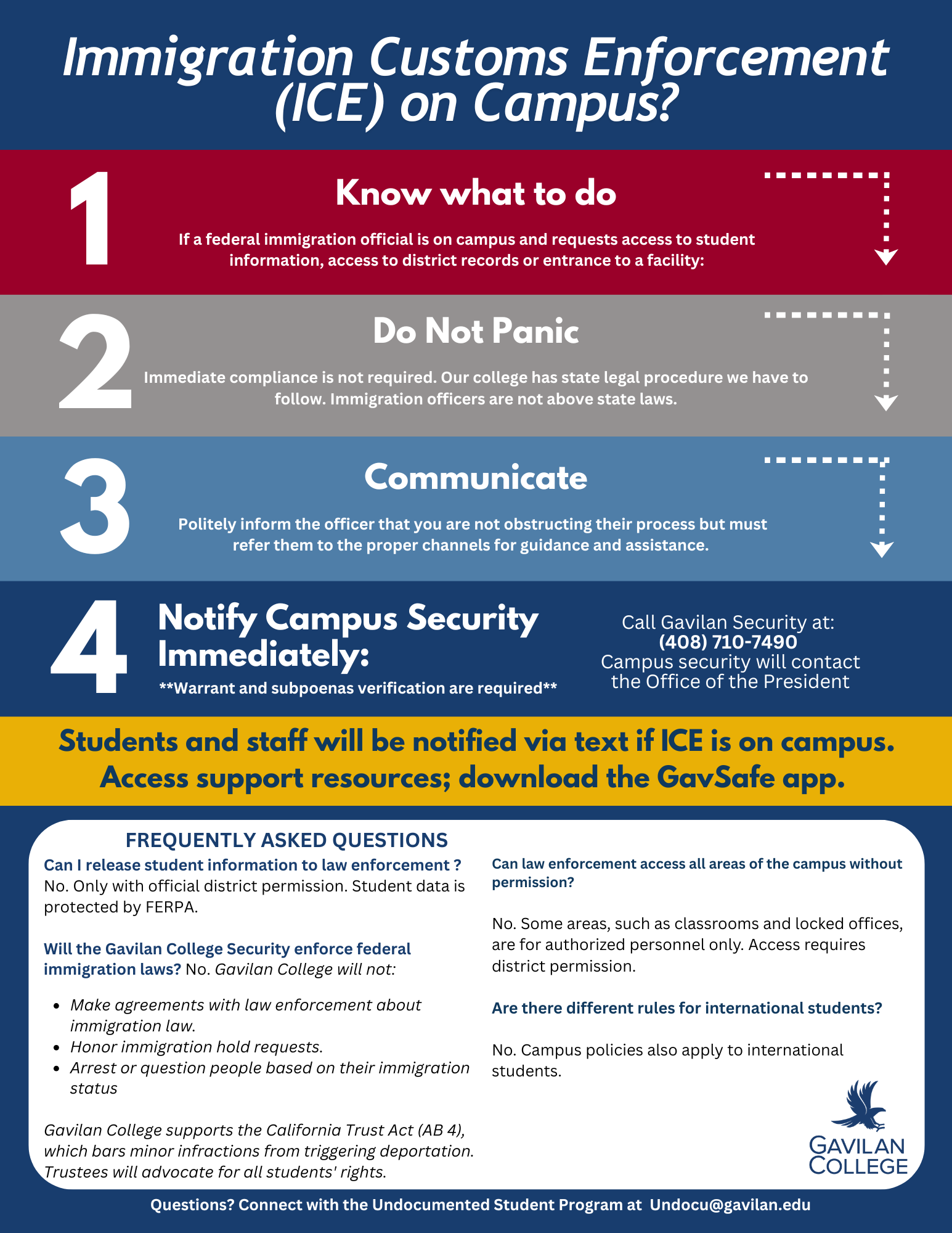
Immigration Officials or Law Enforcement on Campus
All Gavilan College employees must adhere to the Family Educational Rights and Privacy Act (FERPA). FERPA protects the privacy of student educational records and all personally identifiable information contained in those records. The college and its employees cannot disclose information about students without the student’s written consent, even to federal authorities.
Gavilan College will comply with the California Values Act (SB 54) and will not expend any Gavilan law enforcement resources on immigration enforcement or immigration information-gathering activities.
In the unlikely event that U.S. Border Control, Immigration and Customs Enforcement (ICE) or any other federal law enforcement agency comes to any Gavilan College campus or facility, please contact Campus Security immediately at (408) 710-7490.
FAQ's for Faculty and Staff
In the unlikely event that U.S. Border Control, Immigration and Customs Enforcement (ICE), or any other federal law enforcement agency comes to any Gavilan College's work area (office, classroom, etc.), please follow these steps:
1. Please contact Campus Security immediately at (408) 710-7490.
-
Refer the agents to Gavilan College Campus Security immediately at (408) 710-7490 (or extension 7490 from a campus phone) to report the situation and request guidance.
-
Inform students of their rights:
If you can safely communicate with a student, let them know they have the right to remain silent and to request legal representation. They are not required to disclose their immigration status without legal counsel present. -
Remind individuals in your workplace of their rights:
Students, faculty, and staff have the right to remain silent and are not required to disclose immigration status. Do not instruct or order anyone to remain silent; simply remind them of their rights. -
Conduct yourself professionally:
Remain calm and respectful when interacting with immigration or law enforcement officials. Avoid casual conversation and do not provide any information about students or employees without direction from Campus Security or the Office of the President. -
Do not resist if ICE agents force entry:
You may state, “I do not consent to your entry,” but do not physically resist.
(Source: ACLU Northern California — “Know Your Rights if ICE Confronts You”) -
Do not sign any documents.
Wait for legal guidance before signing or acknowledging any paperwork presented by immigration or law enforcement officers.
In the unlikely event that ICE or non-Gavilan College Security approaches you on campus, it’s important to know your rights and how to respond.
Know Your Rights
-
You have the right to remain silent. You can say:
-
"I reserve the right to remain silent based on my 5th Amendment rights under the US Constitution."
-
"I do not wish to speak with you, answer your questions, or sign any documents."
-
-
Do not disclose your immigration status without legal counsel present.
-
Do not sign any documents.
-
Do not resist physically. If ICE agents force their way in, state: "I do not consent to your entry," but do not obstruct them.
-
Conduct yourself professionally. Stay calm, and do not run, argue, or provide false information.
-
Use a Red Card to assert your rights. See ILRC red cards and CHIRLA red cards.
If You See ICE on Campus
-
In a classroom or center: Refer the officer to the instructor or office staff present.
-
In the unlikely event that U.S. Border Control, Immigration and Customs Enforcement (ICE) or any other federal law enforcement agency comes to any Gavilan College campus or facility, please contact Campus Security immediately at (408) 710-7490.
Know Your Rights: “Red Cards”
These “Red Cards” inform individuals of their constitutional rights when interacting with immigration enforcement officers. The cards provide clear instructions on how to assert the right to remain silent, refuse searches without a warrant, and request legal representation. They are designed to help reduce fear, ensure due process, and empower individuals to respond appropriately in high-pressure situations.
Red Cards are available in English, Spanish/English, Hmong/English, Ukrainian/English, Russian/English, Tagalog/English, and Farsi/English, with Vietnamese, Cantonese, and Mandarin versions coming soon.
Faculty and staff at Gavilan College may request Red Cards by emailing Undocu@gavilan.edu or contacting the Undocu Liaison - Dream Resource Liaison, Omar Macias in the Undocumented students page for Gavilan College.
Gavilan College Update on Support for Our Undocumented Community
Resources:
- Family preparedness plan – Every family should have one in place. Review this family preparedness guide from the Immigration Legal Resource Center (ILRC).
- Videos and tutorials:
-
(408) 290-1144
-
(831) 204-8082
-
(831) 239-4289
-
(831) 204-8082
By staying informed and prepared, you can help protect yourself and others in your community.
Legal Consultations
The UFW Foundation, in collaboration with Gavilan College, offers free virtual and in-person immigration consultations to Gavilan College students, Faculty, and Professional Staff. UFW Foundation immigration services include:
- Immigration Relief Screenings
- DACA Renewals
- Advance Parole
- Naturalization/Citizenship
- Adjustment of Status
- Family-Based Immigration
- Know Your Rights
Our college offers both in-person and virtual consultations. To make an appointment with the UFW Foundation, visit Find Your Ally.
*You are NOT required to state the nature of your case/question to a staff member to make an appointment with a legal representative.
Note: If you schedule an appointment with the UFW Foundation, please be aware that you might get contacted if your appointment changes (e.g., from in-person to virtual or nay changes).
If you need urgent assistance and no appointments are available, please reach out to your college’s Dream Resource Liaison for further support.
- Amnesty International
- California Community Colleges Chancellor's Office – Resources for Undocumented Students
- California Immigrant Policy Center – Call (916) 448-6762 or email info@caimmigrant.org.
- Coalition for Humane Immigrant Rights (CHIRLA)
- Council on American Islamic Council Relations
- International Rescue Committee Sacramento – Call (916) 482-0120 or email northerncalifornia@rescue.org.
- Immigrant Legal Resource Center
- Immigrants Rising
- Jewish Community Relations Council
- Immigration Advocates Network
- Mexican American Legal Defense and Educational Fund
- My Undocumented Life
- National Immigration Law Center – Call (213) 639-3900 or email reply@nilc.org.
- United We Dream
FAQ's
Public vs. Private Spaces
It is a public space, open to anyone in our community. Each campus has specific, unique spaces that may be interpreted as public or private. In general, any space where students or the public have unfettered access is considered public. The definition of "private space" is open to legal interpretation. We will do everything in our power to protect the privacy of classrooms and other private spaces; however, we cannot guarantee that law enforcement agencies share that same interpretation.
Posting signage may help clarify the difference between public and private space; however, we should be clear that signage is unlikely to prevent federal law enforcement from entering if that's their interest. The definition of "private space" is open to legal interpretation. We will do everything in our power to protect the privacy of classrooms and other private spaces; however, we cannot guarantee that law enforcement agencies share that same interpretation.
Yes, nothing prevents you from locking your classroom if it is something that you normally do. Faculty may choose to consider putting their classroom locked door policy in their class syllabus, establishing it as a common practice not necessarily related to immigration enforcement. Even if classroom doors are locked, law enforcement can still enter with a valid judicial warrant.
Immigration Enforcement Authority Interactions
Respond with the following:
“California law and college policy don’t allow me to share information or grant access. My district policy states that I need to contact campus security to assist you.”
We do not expect every Gavilan College employee to be able to recognize or validate a judicial warrant. Any employee presented with a document that is suggested to be a warrant should contact the Gavilan College Security Office immediately and let Security and the office of the President assess the document’s validity.
Gavilan College does not advise any employee to obstruct access to law enforcement officials. If federal law enforcement will not wait for Gavilan College Security, we do not recommend impeding their access.
Yes. There are no statutes that prevent you from videoing your interaction with immigration enforcement authorities, so long as the recording does not impede the movement or interfere with the actions of the immigration officers.
Contact the Gavilan College Security Office at (408) 710-7490. Allow them to authenticate the warrant.
Staff should contact the Gavilan College Security Office at (408) 710-7490 and inform the federal agent to wait in the public area while security arrives. Staff should not provide voluntary consent to the agents to enter non-public areas and should avoid answering any questions to protect the FERPA rights of students and staff.
Employee Protections
If you acted within the scope of your employment and followed the "Law enforcement Pocket Cards" instructions, Gavilan College will support you.
Based on the specific circumstances and consistent with Gavilan College collective bargaining agreements, Gavilan College will work with the employee and labor union (if the employee is represented) to maintain the employee’s job status; including employment and any potential disciplinary action, to the fullest extent possible while the employee is detained.
If a student or staff member is detained, please be prepared to provide Gavilan College Security Office and college officials with the name and, if possible, Gavilan ID of any individual(s) detained.
Staff should always contact Gavilan College Security Office first so they can contact the President's Office and have them review the federal order before detention. If an individual is detained, Gavilan College Security Office along with the Office of the president will collect information regarding the federal agent, the federal order, the individual detained, the reason for detention, and any other relevant details.
Legal Risks
Actions such as physically blocking doors, locking doors only when immigration enforcement authorities attempt to enter, or pushing an immigration enforcement agent. These may be considered an obstruction. Always call security and follow the ICE information flyer. Never physically touch an immigration enforcement authority agent, as penalties are severe.
This is strongly discouraged. Such actions may be interpreted as aiding and abetting or harboring a fugitive, which carry serious legal consequences.
Staff should be aware that anyone who knowingly assists an individual in evading federal immigration authorities can be charged with a felony under federal law (8 USC § 1324) which prohibits "concealing or harboring" an individual who is in the United States illegally.
It is a felony to obstruct or intentionally interfere with a federal law enforcement agent. Please inform the federal agent that you do not consent to the agent's demand, but do not attempt to physically stop the agent. A physical altercation with a federal agent may result in arrest or physical injury.
You may be charged with 8 USC 1324, which is a federal offense. Staff should be aware that anyone who knowingly assists an individual in evading federal immigration authorities can be charged with a felony under federal law (8 USC § 1324) which prohibits "concealing or harboring" an individual who is in the United States illegally.
Under the Constitution, every individual has the right to remain silent without repercussions. Immigration enforcement authorities may still exercise their enforcement objectives if they have a judicial warrant, however that does not limit your right under the 5th Amendment to remain silent or ask for an attorney.
Yes, trusted community resources can be shared; that is not a violation of the law.